
By: Stephanie Klingbeil
Picture this: It’s 2 a.m., and you’re hunched over a laptop. Your math notes are scattered like confetti, your brain is fried, and the only thing keeping you awake is the leftover Halloween candy you just remember still counts as food. Sound familiar? If so, you’re not alone.
Academic stress is the invisible backpack too many teens are lugging around–and it’s getting heavier. Standardized testing and academic performance have become overwhelming benchmarks, not
just of success, but of self-worth. And it’s costing teens their mental health.
While “stressed” might be “desserts” spelled backwards, there’s nothing sweet about the pressure
teens face in today’s school environments. It’s time we ask: What can schools actually do to give students
a break?
The Standardized Testing Trap
Schools are meant to be places of learning, growth, and discovery. But when the culture revolves around test prep and GPA obsession, students begin to internalize a dangerous message: You are only as good as your score.
In fact, according to recent studies, a whopping 75% of high school students report experiencing significant stress due to schoolwork (American Institute of Stress, 2025). Standardized testing, in
particular, has become a primary source of this anxiety, with 87% of teens saying it increases their stress levels (LA Times High School Insider, 2022). These stressors can take a major toll, not only on grades but
also on other areas of life like sleep, relationships, exercise, and so much more.
So What Exactly is Academic Stress?
Well, academic stress is the mental distress students experience due to academic demands. It’s driven by deadlines, performance pressure, and fear of failure. For teens, this stress is magnified during standardized testing season. According to the National Bureau of Economic Research, students’ cortisol levels (a marker for stress) increase by 15% during testing periods (NBER, 2019).
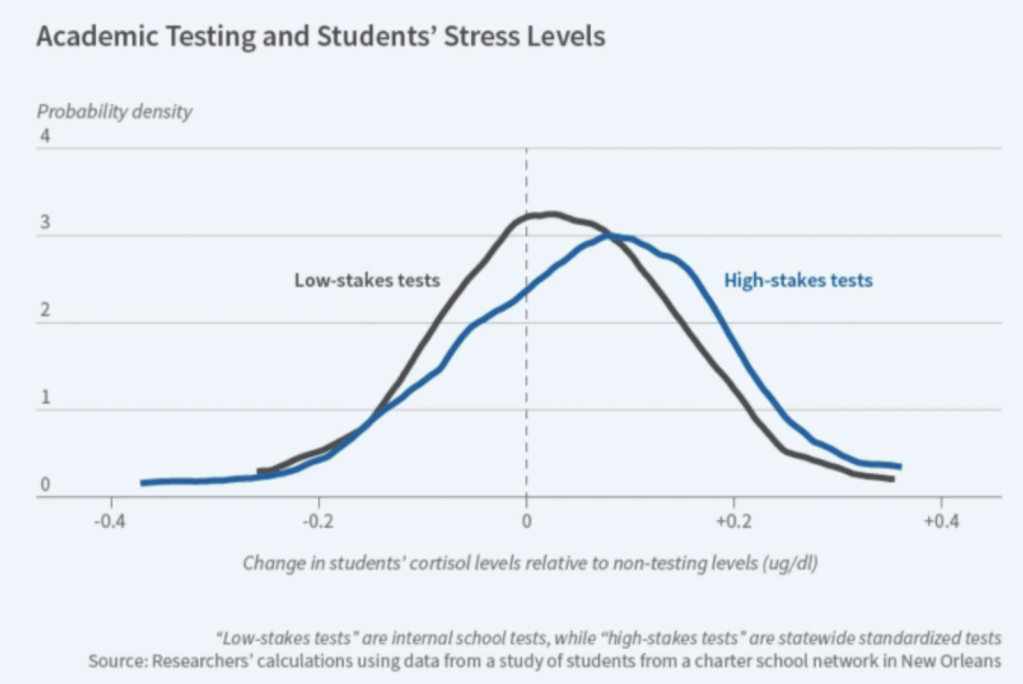
For some, this stress is motivating, but for many, it’s debilitating. Students may experience sleep issues, panic attacks, or feelings of hopelessness. In severe cases, it can lead to anxiety disorders or depression. Girls are especially vulnerable: according to the National Institute of Health, they report higher levels of school-related stress than boys.
Why Self-Concept and Academic Self-Efficacy Matter
While we often talk about standardized testing as a one-size-fits-all system, the truth is that how a student experiences testing stress depends a lot on how they see themselves. Enter: self-concept (how you view your abilities) and academic self-efficacy (how confident you feel about succeeding academically). Students with high self-efficacy are more resilient. They view challenges, like a big test, not as threats but as opportunities to grow. Unfortunately, standardized testing can eat away at that confidence. When a student repeatedly scores lower than expected, they might start to believe they’re not smart or capable, even when the test doesn’t reflect their true abilities.
What Schools Can and Should Do
While personal mindset matters, it’s not enough to put the onus solely on teens. Schools play a major role in either adding to stress or alleviating it.
Here are 5 things that schools can do to help teens:
- Offer Alternative Assessments: High-stakes tests shouldn’t be the only way to measure learning. Project-based evaluations and portfolios can give students a chance to demonstrate skills in less stressful formats. These methods are effective because they focus on practical application.
and creativity, which can boost student engagement and reduce anxiety. - Teaching Coping Strategies: Schools can offer workshops on stress management, mindfulness, and relaxation techniques. Programs like the Compassionate Schools Project have improved student emotional regulation and well-being. Teaching these skills equips students with tools to manage emotions during high-pressure situations, leading to better mental health outcomes and boosting students’ overall stress management in the long run.
- Incorporate Social-Emotional Learning (SEL): SEL programs help students build emotional awareness, empathy, and conflict resolution skills. Research from CASEL (Collaborative for Academic, Social, and Emotional Learning) shows that SEL improves academic performance, reduces emotional distress, and increases positive social behaviours.
- Normalize Mental Health Support: Making counselling services accessible and actively encouraging students to use them can reduce stigma and offer teens the support they need. When students feel safe reaching out for help, they’re more likely to manage stress before it escalates. Remember: There is never shame in asking or receiving help!
- Create a Culture of Support, Not Competition: Educators and administrators should emphasize growth, effort, and collaboration, not just achievement. This mindset shift reduces peer comparison and performance anxiety, helping students feel more secure in their learning journey.
Rethinking the School Experience
Now, picture this: a student who once crumbled under the weight of weekly exams now beams with pride while presenting a collaborative project. Another, who used to dread report card day, now finds joy in learning through hands-on experiments. These aren’t just hopeful stories, they’re possible outcomes when schools intentionally shift their approach.
Remember that student hunched over a laptop at 2 a.m., fueled by leftover Halloween candy and panic? What if, instead, that same student felt prepared, not because they pulled an all-nighter, but because they were taught how to manage pressure, how to believe in their abilities, and how to learn in ways that actually made sense to them? What if they weren’t cramming to survive a test, but engaging to thrive in their education?
We don’t need to eliminate academic rigor, but we do need to rethink how we define success. When 75% of students are stressed and nearly 90% say testing makes it worse, we must ask: What are we really teaching? The most important lessons teens should be learning in school aren’t just how to take a test, they’re how to manage stress, believe in themselves, and maintain their mental health. Schools have the tools to make that possible. Now it’s time to use them, because when we turn stress around, maybe
students can finally get a little piece of that “dessert.”
Sources
CASEL. “What Does the Research Say?” CASEL, Collaborative for Academic, Social, and Emotional
Learning, 2022, casel.org/fundamentals-of-sel/what-does-the-research-say/.
Fitzgerald, Jay. “Test-Related Stress and Student Scores on High-Stakes Exams.” National Bureau of
Economic Research, 3 Mar. 2019,
http://www.nber.org/digest/mar19/test-related-stress-and-student-scores-high-stakes-exams.
Graves, B. Sue, et al. “Gender Differences in Perceived Stress and Coping among College Students.”
PLOS ONE, vol. 16, no. 8, 12 Aug. 2021, http://www.ncbi.nlm.nih.gov/pmc/articles/PMC8360537/,
https://doi.org/10.1371/journal.pone.0255634.
Luu, Emma. “Opinion: Standardized Testing Takes a Toll on Students’ Mental Health.” HS Insider, 24
June 2022,
highschool.latimes.com/opinion/opinion-standardized-testing-takes-a-toll-on-students-mental-health/.
Oaklander, Mandy. “The Mindful Classroom.” Time, 22 Sept. 2016,
time.com/4504021/the-mindful-classroom/.
Terada, Youki. “The Psychological Toll of High-Stakes Testing.” Edutopia, 14 Oct. 2022,
http://www.edutopia.org/article/psychological-toll-high-stakes-testing.
The American Institute of Stress. “TEENS & YOUNG ADULTS – the American Institute of Stress.” The
American Institute of Stress, 14 Jan. 2025, http://www.stress.org/who-gets-stressed/teens-young-adults/.
Header Image Credit: https://www.nordangliaeducation.com/sta-bangkok/news/2024/01/03/how-to-manage-academic-stress


 Mind4Youth
Leave a reply to inventivef9c09dc73e Cancel reply