By: Siya Shetty
The Impact of Attention Span, Procrastination, and Stress in Teens
If you’ve ever sat down to start your homework and found yourself scrolling through your phone instead of doing your work then you know how short attention spans can make it tough to focus.
Procrastination is actually very common, it happens when you intentionally delay tasks that have deadlines, whether it’s school assignments, chores, or even simple responsibilities like appointments and making plans (González-Brignardello et al.). For teens, distractions like social media, notifications, or a packed schedule can make it even harder to get started and unfortunately this turns small delays into a growing pile of unfinished work.
It’s not just about being “lazy” or being bad at time management, procrastination is linked to emotional and cognitive factors, in which some examples being anxiety and perfectionism. If you usually have set very high expectations for yourself, you may avoid those tasks because you worry you won’t do them perfectly, which only increases the procrastination (Pérez-Jorge et al.). The more stress and anxiety you can get if you continuously keep putting things off and this can make it harder to focus or even to start the task at hand.
Having to learn how to manage your attention and emotions can be quite tricky, especially for teens and young adults since their brains are in a constant stage of development (Pérez-Jorge et al.). Luckily, when we understand what and how our attention spans are related to the stresses of procrastination it can help us break this cycle before it gets too overwhelming and we can start taking baby steps in order to manage your tasks more effectively and reduce the repeated stress factors.
How Limited Attention Leads to Procrastination and Stress
When your attention is limited, it becomes much harder to stay focused on a single task, and this is one of the main reasons how procrastination starts.
Being able to focus on what’s important and ignoring the distractions is very important for learning, remembering, and the brain processing, but this can also be challenging for teens during school or study time because of the endless distractions one may face (Hobbiss and Lavie). If you constantly find yourself switching between your social media to your messages, or zoning out to the background noises while trying to study, that means that your brain isn’t fully engaged with the task. This, unfortunately, makes it feel harder and less rewarding to start or finish your work. Interestingly, tasks that demand more focus and have a higher “perceptual load” can actually help keep your attention locked in due to more things needing to be done, making it easier to concentrate and ignore the distractions.
On the other hand, when a task has low-effort or is not very engaging, then this makes your attention span drift automatically toward the irrelevant things things around you: like the need to check your notifications or worry about other side activities (Bruckmaier et al., as cited in Torralbo et al.). When you leave your tasks undone or even half completed, then this creates a slow increase of the stress about upcoming deadlines. This means that the cycle feeds itself, limited attention leads to procrastination, which makes you wanting to leave tasks unfinished, and these unfinished tasks makes you feel more overwhelmed and stressed. You can realize why starting or finishing tasks can feel so difficult and why distractions hit harder than you may expect by understanding how attention works. Knowing that your brain naturally struggles to keep a focus on the the low-engagement tasks that you have, can help you build a plan to keep your attention where it matters and reduce that feeling of a stress buildup.
The Procrastination–Stress Cycle, Through Those Experienced it
If you ever think that you have enough time in order to get a task done then you’ve probably put it off by suddenly cleaning your desk, checking your phone, or even something as simple as looking outside at nature. Doing anything else except the work you actually need to do, is the true birth of procrastination.
“What triggers students to clean out closets or wax the car when it’s time to work on their statistics paper? Usually it’s self-doubt,” says procrastination researcher Timothy A. Pychyl (Novotney). Some teens may even think they work best under pressure, but the data shows this has only worked small amounts of times. “Students seem to remember the one time that maybe waiting until the last minute did pay off with a good grade, but they forget the other nine times when it didn’t,” explains Joseph Ferrari (Novotney).
Even high-achieving students aren’t safe from this habit. “Graduate students worry about performing inadequately or fear their success may raise others’ expectations of them,” Ferrari adds (Novotney). Over time, those little delays start stacking up, and the stress of unfinished tasks begins to slowly creep in. The longer you put things off,, the more overwhelming the work feels, and then focusing on it becomes even harder. The first true step to breaking this procrastination–stress cycle is by simply acknowledging it, so that you can find ways to help you manage both your tasks and your stress effectively.
The Brain Science Behind Attention Limits and Mental Overload
Your brain isn’t designed to focus on everything at once. Your attention does have a limit to it, which means that when there are too many distractions competing for it, then your focus will naturally weaken. Betteridge et al. researched how “Today, teens spend an average of about 7.5 hours a day on screens, which is a major increase compared to the 1990s, and this heavy technology use has been linked to increased excitability, poorer sleep, constant multitasking, and a stronger desire for immediate rewards.” When your brain gets too used to the quick stimulation from screens, especially when it involves watching scrolling on short videos, it makes slower tasks like homework feel boring or harder to stay fully engaged with. Research also shows that distractions, whether it is from outside noises or your own wandering thoughts, can interfere with your ability to stay focused and increase the chances of your mind wandering (Hobbiss and Lavie).
When your attention keeps jumping from one thing to another, your brain starts to feel overloaded. You begin a task, get distracted, come back to it, and then repeat the whole cycle again. That back‑and‑forth uses way more mental energy than simply staying focused from the start. On top of that, people procrastinate for different reasons — some students deal with anxiety, fear of failure, low motivation, gender or age differences, or even a lack of support at home (Ramadhani et al.).
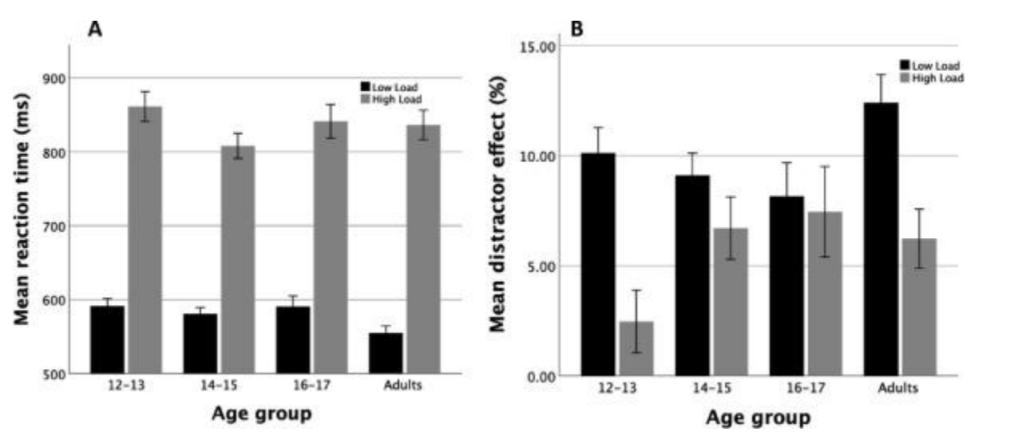
RT as a function of load and age and distractor conditions is presented in Fig. 1. Source: Michael H. Hobbiss, Nilli Lavie, Sustained selective attention in adolescence: Cognitive development and predictors of distractibility at school, Journal of
Experimental Child Psychology,
Volume 238, 2024, 105784, ISSN 0022-0965, https://doi.org/10.1016/j.jecp.2023.105784
Sustained selective attention in adolescence: Cognitive development and predictors of distractibility at school – ScienceDirect
This basically means that attention issues and procrastination are tied to both how your brain handles focus and how your emotions shape your behavior. Because of that, there isn’t one solution that works for everyone. The good news is that once you understand how you respond to distractions and stress, you can start finding strategies that actually fit your needs instead of blaming yourself for losing focus.
Breaking the Cycle: Simple Strategies That Actually Help
Now it comes down to our main question, the finale if you will. How do we deal with procrastination?
Well, for starters, you need to realize that procrastination really isn’t just about laziness. It’s more about the stress and distraction that are working together. The good news is that there are simple ways to take back your attention span control.
Many people online or even friends or family have probably told you to “stay organize” in order to be on top of everything. Though you may have thought to your self, staying organized isn’t the only solution. Actually, staying organized makes a bigger difference than you might think. “Never underestimate the power of organizing. A planner or digital calendar can help you stay on top of all your assignments” (Tutor Peers). Writing tasks down, (even if they are the most simplest things like take the trash out on Thursday), and crossing them off keeps things from building up and gives you a small sense of accomplishment.
While trying to maintain a good work habit, managing your stress matters too. Since stress is known to make procrastination worse, techniques like deep breathing, short workouts, or even a quick nap can help improve your focus and mood so that you can be able to lock into what you need to get done (Tutor Peers). When big projects feel overwhelming, try breaking them into smaller steps like “choose a topic” instead of “write the whole essay.” Smaller tasks are known to feel less intimidating and easier to start with (Northpoint Specialist).
In todays digitally captured world, it is easy to admit that it is pretty hard to cut distractions. But taking the initiative to turn off your phone or any screens really does help you with bringing back the reality. One way to stay grounded and focus on what matters, is by using the Pomodoro Technique. This is a 25 minutes of focused work followed by a 5-minute break that can train your brain to stay on task (Uche).
And let’s face it, reading or watching videos about productivity can only go so far. What really makes a difference is actually using these techniques, to build small habits, accomplishing tiny goals, and making sure your are consistent with them, are the true impactful ways that you can slowly reduce the need to procrastinate. Progress doesn’t happen all at once, but it does happen when you start.

 Mind4Youth
Leave a comment