By: Deepika Solanki
INTRODUCTION
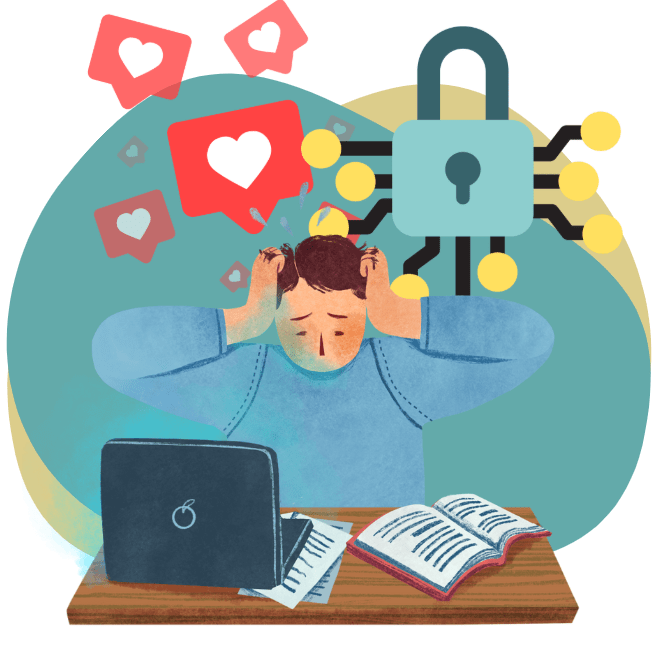
Living in a hyper-connected era, instant tech rewards make self-regulation challenging. Being glued to our phone or obsessing over new tech may indicate technostress, negatively impacting mental health and overall psychological well-being. The relentless pace of technological advances and constant connectivity disrupts work-life balance, emphasizing the need to recognize and manage technostress in today’s digital society
First coined by psychotherapist Craig Brod in his 1984 book, Technostress refers to the psychological stress or discomfort arising from using new technologies. The study demonstrates that psychological outcomes have a more immediate impact compared to behavioral ones. Brod’s book further states that “technostress” is “a modern disease of adaptation” caused by people’s inability to adapt to new computer technology appropriately. A fundamental concept which represents an early understanding of the challenges of rapid technological progress. Following Brod’s lead, academics have widened the definition of technostress to include the psychological and emotional effects of technology overload.
EFFECTS OF TECHNOSTRESS
Technostress exerts a profound psychological impact, creating a constant state of arousal and anxiety. Information overload, digital demands, and perpetual connectivity contribute to cognitive fatigue and reduced attention spans. The pressure to keep up with evolving technology can induce feelings of inadequacy and fear of obsolescence. Social comparison, amplified by online platforms, fosters a sense of competition and anxiety. Additionally, the blurring of boundaries between work and personal life intensifies stress. Overall, technostress can lead to burnout, decreased job satisfaction, and negatively impact mental well-being.
From the literature and observations mentioned above, it has been identified that technostress has become increasingly relevant and deserving of scholarly attention, especially in today’s rapidly evolving technological landscape. Existing technostress literature reviews have revealed the multifaceted nature of technostress, highlighting its potential for both positive and negative influence; studies have also identified the various sources of technostress, all of which can contribute to developing conceptual models, to determine impacts on job outcomes, to identify stressors, health and work outcomes, and distinguishing work-related and non-work-related sources. Information and Communication Technology (ICT) has become a significant aspect of human existence, offering numerous benefits and corresponding adverse effects.
INTERVENTIONS
But there are some simple ways to help you stay in check with the screens. To cope with technostress, establish digital boundaries. Set specific times for device use and designate tech-free zones to restore work-life balance. Practice mindfulness by engaging in activities without screens, fostering mental rejuvenation. Regularly disconnect from email and social media to reduce information overload. Prioritize self-care with breaks and physical activities. Embrace digital detox days to recalibrate. Cultivate a supportive work environment that encourages breaks and acknowledges the impact of constant connectivity. Develop awareness of technological triggers and implement stress management techniques, such as deep breathing or meditation.
Seek professional help if the above technostressors significantly seem to affect your mental health. Finally, reassess and improve technology use habits, emphasizing quality over quantity to enhance well-being in the digital age.
REFERENCES
- Kumar, P. S. (2024). TECHNOSTRESS: A comprehensive literature review on dimensions, impacts, and management strategies. Computers in Human Behavior Reports, 16, 100475. https://doi.org/10.1016/j.chbr.2024.100475
- Tarafdar, M., Tu, Q., Ragu-Nathan, B. S., & Ragu-Nathan, T. S. (2007). The Impact of Technostress on Role Stress and Productivity. Journal of Management Information Systems, 24(1), 301–328. https://doi.org/10.2753/mis0742-1222240109
- Lee, Y., Chang, C., Lin, Y., & Cheng, Z. (2013). The dark side of smartphone usage: Psychological traits, compulsive behavior and technostress. Computers in Human Behavior, 31, 373–383. https://doi.org/10.1016/j.chb.2013.10.047

 Mind4Youth
Leave a comment