By: Payton Lee
Introduction: The Hidden Struggle Among Teens
In a world of social media highlight reels, academic pressure, and rising expectations from parents, teachers, and peers, many teenagers today silently battle a powerful internal force: perfectionism. While striving to do well can be healthy, perfectionism often crosses the line into harmful mental
territory, causing anxiety, depression, burnout, and low self-esteem. In fact, research by psychologists Andrew Hill, PhD, and Thomas Curran analyzed over 246 studies involving 41,000 students across three major countries: Canada, the United Kingdom, and the United States. They found that specific forms of perfectionism among teens have significantly increased over the
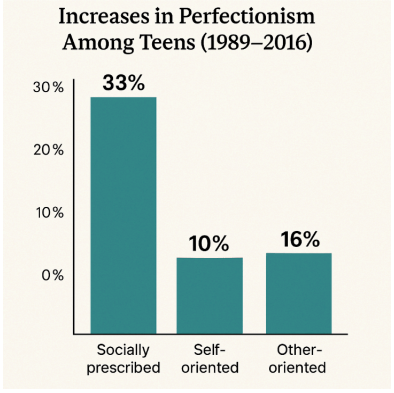
past few decades: “Socially prescribed perfectionism spiked most
dramatically, showing a 33% increase over the study period. That was more than double the 10% increase seen in self-oriented perfectionism and the 16% rise in other-oriented perfectionism, the researchers found.” But the good news? There are ways to understand, manage, and overcome this mindset.
What is Perfectionism?
Perfectionism is more than simply wanting to do your best. It involves setting unrealistically high expectations, being overly critical of mistakes, and tying one’s self-worth to achievements. For teens, this may look like a fear of failure, procrastinating studying due to high expectations from parents or peer, or a constant feeling that nothing is ever good enough. Many others might also find themselves incessantly comparing their lives to their peers or overworking just to feel like they’re doing “okay.”
The Impact of Perfectionism on Teen Mental Health
Perfectionism is not the same as wanting to do your best. It’s really about
setting unreasonably high standards, excessively self-criticizing over mistakes, and basing one’s self-worth on achievement. For adolescents, it can manifest as a fear of failure, procrastination due to expecting too much from oneself, or developing a nagging feeling that nothing is ever “good enough.” Many others can also

become perpetually comparing their lives to others or working way too hard just to feel as though they’re getting “okay” done.
While talking to a high school friend, he gives his honest opinion about how he feels about school: “I feel like I can’t make any mistakes. If I don’t get straight A’s or the highest scores, I feel like a failure.” This mindset can create a negative cycle of pressure, shame, and burnout.
Real-Life Insight from a Medical Professional
Dr. Daniel Blanchard, a cardiologist at UCSD Health, reflected on his experience with stress during medical school and residency: “The way I coped with all the stress was that I had two or three mentors and friends pushing me along the way, guiding me and relieving me from all the work I had on my day-to-day studying.” His words highlight the power and importance of support, reminding us that even those in highly respected fields benefit from connection and balance.
Dr. Blanchard’s story is a powerful reminder that success does not have to come at the cost of mental health. Seeking help or learning from others is not a weakness; it is a strength.
Why Teens Struggle with Perfectionism Today
Several factors contribute to rising perfectionism among teens. Social media platforms, such as Instagram and TikTok, showcase curated, idealized versions of life, which can create unrealistic standards for
beauty, success, and lifestyle. Academically, many teens face immense pressure to earn good grades, get into top colleges, while also trying to keep a social life with friends and family. Parents, even with good intentions may hold their

children to unrealistically high expectations, which in turn can give their children a lifestyle of pressure and stress. Moreover, some teens are simply hardwired to set very high standards for themselves, tying their worth to their performance.
How to Cope with Perfectionism
Overcoming perfectionism requires time and self-compassion. The following are some helpful strategies:
- Practice self-compassion: Mistakes are a part of growth. Speak kindly to yourself.
- Set realistic and flexible goals: Focus on self progress over perfection.
- Limit time on social media or curate your feed to include authentic, positive content.
- Talk to someone you trust deeply and cares about your safety, such as a parent, friend, teacher, or mental health professional.
- Build a support system: Like Dr. Blanchard, surround yourself with people who lift you up rather than down.
Resources for Teens, Parents, and Educators
If you are looking for support, these resources can help:
Teen Line – Call 800-852-8336 or text “TEEN” to 839863 for peer-to-peer support. National Alliance on Mental Illness (NAMI) – nami.org. The Jed Foundation – jedfoundation.org. Mind4Youth Instagram and Website (Articles, stories, and tips updated weekly!). School Counselors and Peer Support Groups: Check your school’s mental health resources.
For parents and educators: Try to focus less on achievements and more on self growth and effort. Model healthy self-talk and open up conversations around failure, resilience, and support-seeking.
The Power of Hope and Support
Perfectionism may feel overwhelming, but adolescents are not alone. With the right tools and support, it is possible to shift from self-criticism to self-compassion.
Acknowledging challenges is the first step; however, believing in your ability to grow is what truly changes lives.

Call to Action: You Deserve Balance and Peace
If you are struggling with perfectionism, know that there is help and hope. Reach out, talk to someone, and remember that your worth is not defined by your grades, awards, or achievements. Perfection is not the goal—-progress is.
For immediate support, call or text the 988 Suicide & Crisis Lifeline.
Let’s work together to create a future where teens feel free to be human—not perfect.

 Mind4Youth
Leave a comment